


High Level Bridge
The Lethbridge Viaduct, or High-Level Bridge, is an iconic image of Lethbridge that has framed views of the city for more than a century.
You can't explore Lethbridge and not get a glimpse of the High Level Bridge. That's like going to Paris and not seeing the Eiffel Tower! An iconic image of Lethbridge, the Lethbridge Viaduct/High Level Bridge has framed views of the city for more than one hundred years. It's also the largest railway structure in Canada and the largest railway trestle bridge in the world, so it's definitely worth some admiration!
Read on below for some of the bridge's best photo ops.
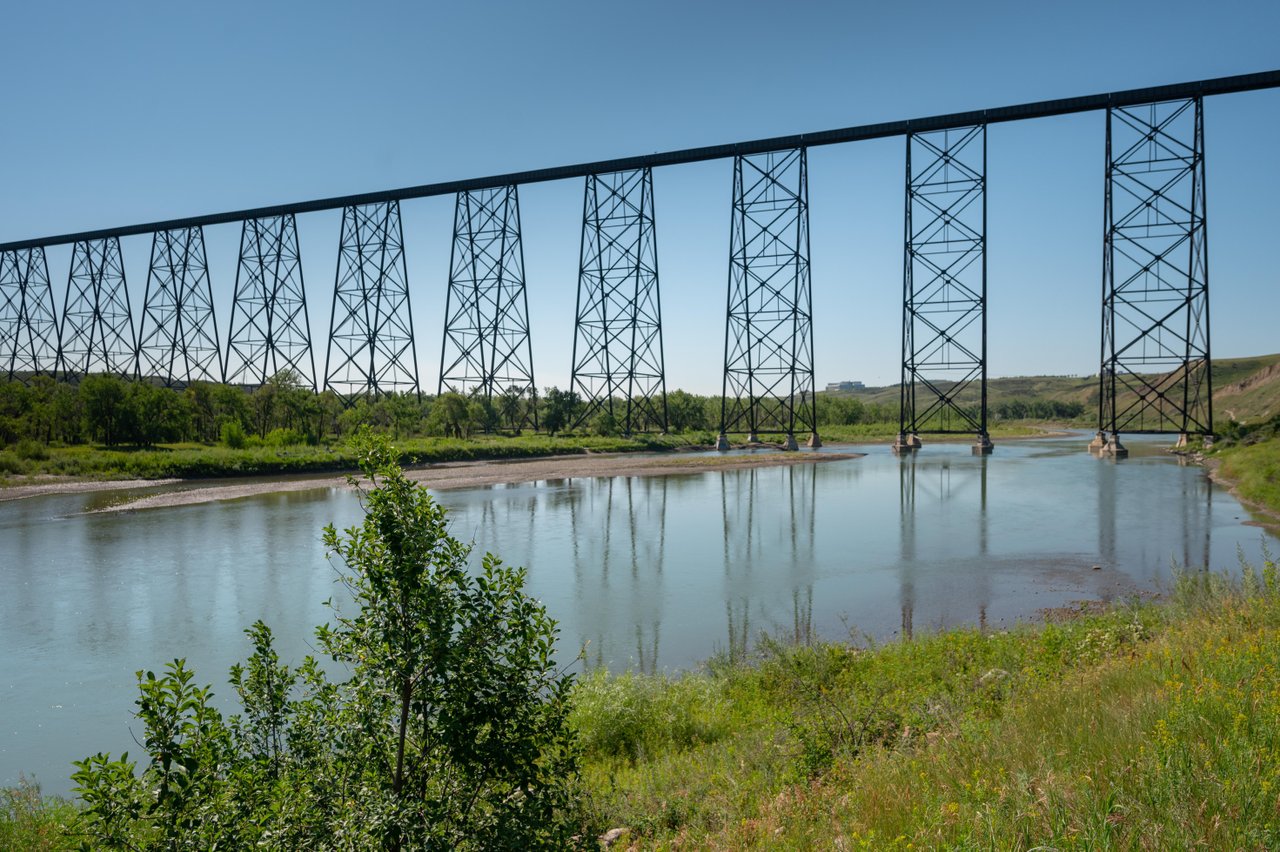
Everything you Need to Know about the Lethbridge High Level Bridge
History
The Lethbridge Viaduct, commonly known as the High Level Bridge, was built out of necessity to accommodate an ever-growing city and the need for a more permanent railway line over the Oldman River. Directed by Canadian Pacific Railway's Assistant Chief Engineer John Edward Schwitzer, construction began in 1907, and all of the steelwork was manufactured by the Canadian Bridge Company in Ontario and transported by hundreds of railway cars.
The High Level Bridge was completed in August 1909. Using 11,200 tonnes of steel and with a length of 1,623.86 metres and a height of 96 metres, the bridge officially became the largest railway trestle bridge in the world. It has still been regularly maintained and remained in use for over a century since its construction, and in 2005, the building of the bridge was recognized as an event of national historical significance.
Fun Facts
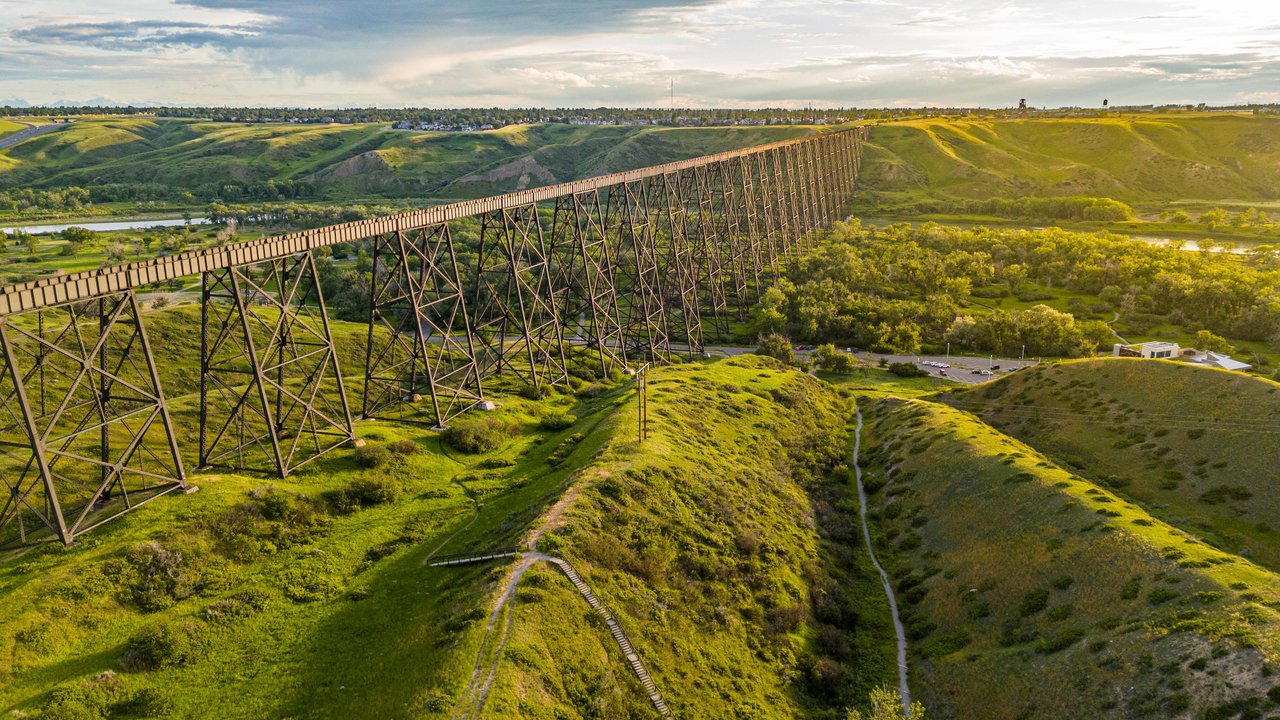
- The Lethbridge train trestle bridge is not just visually impressive, it is big. It's the longest, highest bridge of its kind in the world at 5,327 feet in length and 314 feet high.
- The Government of Canada designated the bridge's construction as a National Historic Event.
Getting There
Getting to the High-Level Bridge is easy and it's really hard to miss. By car, from downtown Lethbridge head west on 3 Ave S and then turn right onto Indian Battle Road towards the Helen Schuler Nature Centre. If you're walking, head towards the Galt Museum, and then choose to take a number of different trails through the coulee down towards the bridge.

Best Spots to See the Lethbridge High Level Bridge
Due to its prominence, the High-Level Bridge can be seen from many vantage points in and around Lethbridge. That being said, there are a few spots around the city that allow for the best photo opportunities. You can't leave Lethbridge without a High-Level Bridge selfie, after all!
Helen Schuler Nature Centre: Their rooftop garden offers superb views. You can also hit the trails and grab a shot directly underneath the mighty bridge.
Galt Museum & Archives/Akaisamitohkanao'pa: Walk west on the trails behind the museum for a view of Fort Whoop-Up below.
City Trails: Whether you're on the west side of the river (such as in Bull Trail Park North), or on the east side, there are over 200 kilometres of city trails with plenty of opportunities to get a shot of the High-Level Bridge. Also, be sure to climb the steps leading to the Lethbridge Viaduct Lookout, one of the best views in town.
Highway 3: Along Highway 3, find the eastbound pullout exit just past the river for a great south-facing view of the bridge.

Frequently Asked Questions About the Lethbridge High Level Bridge
What is the High Level Bridge in Lethbridge, Alberta?
The High Level Bridge - officially known as the Lethbridge Viaduct - is a railway trestle bridge spanning the Oldman River and coulees in Lethbridge. Completed in 1909 by the Canadian Pacific Railway, it is the largest railway structure in Canada and the longest and highest railway trestle bridge in the world, spanning 1,624 metres and standing 96 metres tall. It is still actively used by CPKC trains today.
How big is the Lethbridge High Level Bridge?
The bridge is 1,624 metres (5,327 feet) long and rises 96 metres (314 feet) above the Oldman River. It required 11,200 tonnes of steel to construct and cost $1,334,525, an extraordinary sum at the time. The Canadian Bridge Company in Ontario manufactured all the steelwork, which was transported to Lethbridge by rail.
Is the High Level Bridge a historic site?
Yes. In 2005, the Government of Canada designated the construction of the Lethbridge Viaduct as an event of national historic significance. It has also been recognized as a National Historic Civil Engineering Site by the Canadian Society for Civil Engineering.
Can you walk on or across the High Level Bridge?
No. The bridge is an active CPKC rail line and is private property; both ends are fenced off with no trespassing signs. However, you can walk right up to the base of it and underneath it via the public trails along the Oldman River in Indian Battle Park, which many visitors say is one of the most impressive ways to experience the bridge. There are also metal stairs leading up to a dedicated viewing platform near the bridge.
What are the best spots to see and photograph the High Level Bridge in Lethbridge?
There are several great vantage points around the city. The Helen Schuler Nature Centre offers views from its rooftop garden as well as trails that take you directly underneath the bridge. The Galt Museum & Archives has trails running west toward a viewpoint overlooking Fort Whoop-Up with the bridge as a backdrop. Indian Battle Park is a favourite for photos and up-close views. The Lethbridge Viaduct Lookout (reached via steps from the coulee trails) is one of the best panoramic views in the city. For drivers, the eastbound pullout on Highway 3 just past the river offers a great south-facing angle.
Is the High Level Bridge free to visit?
Viewing the bridge is completely free. The surrounding trails, Indian Battle Park, and the Helen Schuler Nature Centre are all publicly accessible at no cost.
Can you see trains crossing the High Level Bridge?
CPKC trains still cross the bridge regularly, and catching one in motion is a highlight for many visitors, especially when viewed from the trails below in Indian Battle Park or the Oldman River valley.